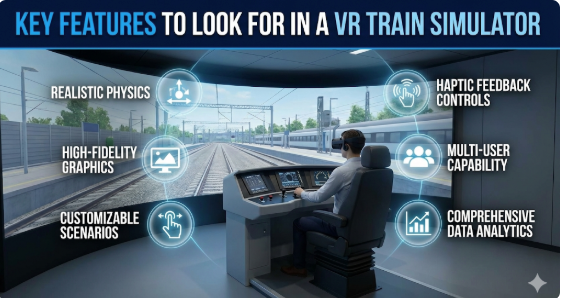
The rail industry is adopting this powerful, immersive technology in a growing number of areas, from training and safety to excel in operation. One of the more enticing developments has been the appearance of a VR train simulator offering infrastructure providers, rail operators, and trainees a safe way to experience the environment of the rail industry.
To improve the capabilities of a driver or to practice in an emergency situation, train simulators are transforming the rail industry, although some are better than others, so knowing what the essential features are in a virtual rail training facility is a must.
High-precision Visual Realism
Visual fidelity: Perhaps the most fundamental aspect of a train simulator is visual fidelity. They employ high-quality graphics and textures, credible light settings, and quick, effective rendering to immerse the user with accurate station, track plans, weather, signals, and other rail assets that look as close to reality as possible.
The higher the accuracy of the images, the greater an understanding the operator achieves of the environment and the sooner he can react. Leading-edge systems will often commission specialist 3D modeling services for the construction of trains, routes, and track infrastructure, all with engineering precision.
Realistic Trains and Track Physics
A good image isn‘t enough. The simulator must show the real physics of a train, including acceleration, deceleration, traction, loads, slope, friction on track, etc. And also exhibit a certain train behaviour in operation at various speeds. The train dynamic becomes significantly crucial for freight trucks, especially ultra-long simulated runs, high-speed trains, and metro trains. Undertaking authentic train dynamics will make it easier to develop real train handling skills and avoid developing undesirable habits.
Real Life Operator Controls
A good experience should support accurate simulators with accurate controls. Not only the control device (see above) but the real controls, i. e. the cockpit of the locomotive. Ensure all buttons, levers, and signals work as in the real machinery, and this will speed up the training process. Custom control optimization is recommended.
Scenario-Based Training Modules
Learning gets more effective in versatile scenarios. Find a simulator whose scenario, based on modules, for example, day-to-day operation, complicated situations, equipment faults, signal failure, disaster, etc. Will have advanced the competence of decision-making under pressure. The system should provide user-friendly menus for designing, editing, and exporting scenarios.
Weather and Surroundings Simulation
External Conditions: The environmental conditions will clearly have a strong influence on train operation and performance. Driving during the rainfall, in the fog, snow, or at low visibility range will all affect the operation. A good simulator should permit changing climate conditions and nighttime and daytime operation.
Permitting climate changes enhances simulation and makes it more realistic for the operators, which will surpass their awareness of safety throughout training and improve general safety. The dynamic conditions will also help to maintain the operator‘s cognition in the simulation.
Performance Monitoring and Analytics
Feedback is essential to compensate for the limitations of training in solitude. Advanced, high-end simulators can generate a vast number of data sets based on a pilot‘s actions, such as air speed, obstacle avoidance, brake action, reaction time, signal validation, and fuel management. This knowledge is used in monitoring strength and weaknesses identification, and innovative reinforcement planning with the data results, based on forming the foundation for future instruction.
Multiple-User, and Educator Control Possibilities
Multi-use usability is also handy for institutions. The teacher will also need to observe the trainee behind his back, include errors, take over the simulation to ‘stop the train on the platform’ and suspend it, and even provide cues. Some systems also permit several operators to utilize the same virtual rail environment, which is an excellent approach for training the drivers, signalers, and Control Room employees simultaneously.
System Capacity and Adaptability
Railways are in a constant state of development, and the training machine should be too. With suitable ‘scalability’, producing new paths, trains, and operating procedures will be easier and faster. When adapted to local signals and operation procedures, the system will then be able to adapt to keep both relevant and affordable.
Input Device Adaptability and Ease of Use
Comfort is also essential since training sessions last for an extensive period of time. The equipment should be compatible with current high-delay, low-latency, ergonomically designed virtual reality helmets. If the hardware isn‘t compatible, a sickness may occur and negatively affect the level of our training. Comfortable and stable mobility is essential to staying focused.
Conclusion
A wisely selected virtual reality train simulator is a business investment that will directly influence training quality, safety performance, and operational efficiencies. By emphasising visual and situational fidelity, real-world physics, control precision and reaction, scenario, environment and task, specific learning, feedback and reporting functions, and scalable evolution, may lead to the achievement of a prosperous long-term development. When all these factors come together strongly, a virtual reality train simulator becomes not only a training device but an essential element to establishing a safe, skilled, and professional rail workforce.